September 2026
Focus Loops Fracture at 41 Minutes, Not 90
Productivity windows break at 41 minutes, not 90—here’s how to restructure your workflow for sharper focus
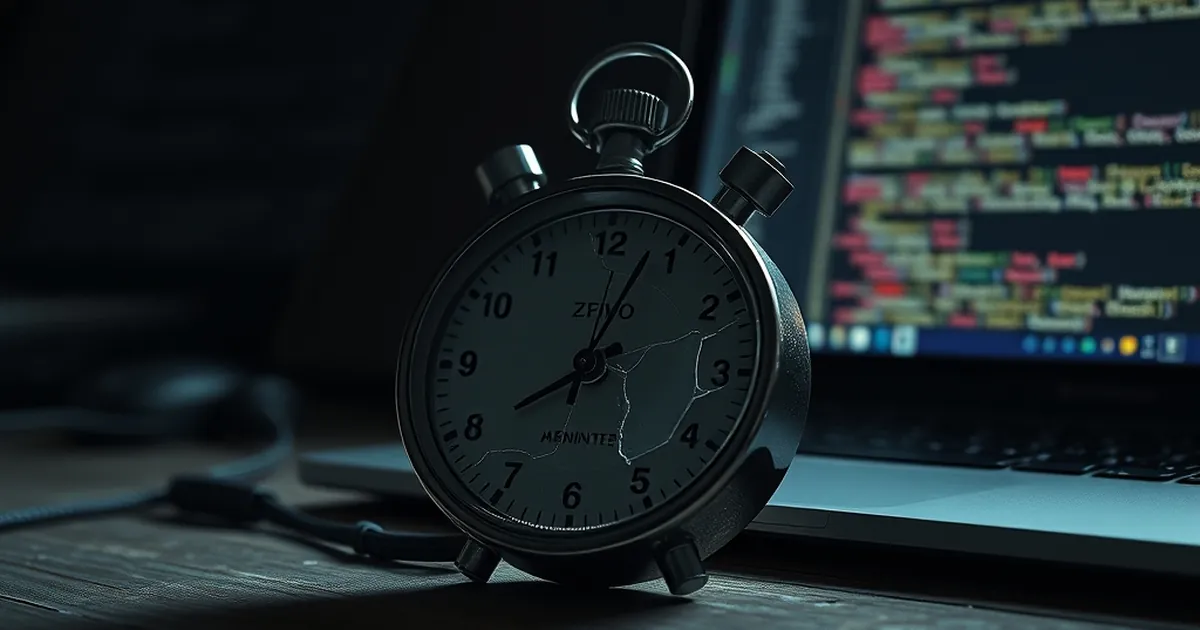
The modern web professional’s relationship with time is a lie we tell ourselves every morning. We block out ninety minutes for a build task, yet the actual productive window—the period where cognitive flow is unbroken and decision-making is sharp—rarely survives past the first half-hour. In Croatia, where the line between "working from home" and "living at work" is often blurred by the proximity of the Adriatic and the lure of a late afternoon kava, this discrepancy is not a minor inconvenience; it is a structural flaw in how we approach digital projects.
The question this article addresses is not how to manage time, but when the mind actually fractures. Specifically, why does your focus loop break at the 41-minute mark, and what does that mean for the architecture of your workday? The answer lies not in better to-do lists, but in understanding the behavioral psychology of reward anticipation and the cognitive cost of context switching—concepts that govern everything from a user's loyalty to your interface to your own ability to ship code before the Dalmatian heat makes thought itself a burden.
The Myth of the 90-Minute Sprint
We have been sold a biological fallacy. The "ultradian rhythm" theory—which suggests our brains naturally cycle through high and low alertness in 90-minute intervals—has been used to justify marathon coding sessions and endless Figma jams. But this theory, popularized by sleep researcher Nathaniel Kleitman, describes sleep cycles, not waking productivity. When applied to complex, high-stakes cognitive work like web development, the 90-minute block is a fantasy.
Research from the University of Illinois at Urbana-Champaign, led by Alejandro Lleras, demonstrated that attention spans on a continuous task begin to significantly degrade after roughly 40 minutes. In his study, participants who took brief breaks (approximately 8 minutes) after 40 minutes of work performed consistently better than those who worked for 60 or 90 minutes straight. The "vigilance decrement"—the natural decline in attention over time—is not linear. It hits a cliff edge around the 41-minute mark.
For a Croatian web developer or designer, this is the moment when the code editor starts to feel like a foreign language. It is when the alignment of a div becomes a Herculean effort. The brain is not tired; it is bored of the same stimulus. The reward loop—the dopamine hit you get from solving a CSS grid puzzle—has exhausted its variable-ratio reinforcement schedule. You are no longer playing the game of creation; you are just staring at the board.
Why 41 Minutes Feels Like a Wall
The specific number is not magic; it is statistical. It represents the average point at which the prefrontal cortex—the region responsible for executive function and complex problem-solving—begins to metabolically fatigue. This is where Daniel Kahneman's work on "System 1" and "System 2" thinking becomes critical. The first 40 minutes of a task are governed by System 2 (slow, deliberate, analytical). This is where you are making architectural decisions about your React components or planning the information hierarchy of a landing page. You are engaged in risk assessment—weighing the cost of a heavy JavaScript library against page load speed.
After 41 minutes, your brain switches to System 1 (fast, automatic, intuitive) to conserve energy. This is dangerous. You begin to make decisions based on habit rather than analysis. You use a div instead of a semantic article tag because it's easier. You ignore the mobile breakpoint because "it's fine." This is not a lack of skill; it is a neurobiological necessity. The brain is actively seeking a different reward because the current one has lost its novelty.
The Psychology of the "Loss Aversion" Loop
Understanding the 41-minute fracture requires a deeper look at why we push past it. The culprit is loss aversion—a concept from prospect theory, also pioneered by Kahneman and Amos Tversky. The pain of losing is psychologically about twice as powerful as the pleasure of gaining. In a work context, we perceive stopping at 41 minutes as a "loss" of momentum. We fear that if we step away, we will lose the thread of the logic, the specific variable name, or the exact spacing in the design system.
This fear is irrational. The loss is not in the break; the loss is in the degraded output of minutes 42 through 90. When you force yourself to continue past the fracture point, you are not coding; you are debugging yourself. You are entering a loop of micro-corrections and reversals—undoing a style, redoing it, changing a function name, and then changing it back. This is the digital equivalent of a gambler chasing losses, but in this case, you are chasing a false state of "flow."
The behavioral concept here is intermittent reinforcement. In the first 40 minutes, every successful function or clean layout provides a predictable reward. After the fracture, the rewards become sporadic. You might solve one issue, which gives a brief dopamine spike, but the subsequent five issues are failures. This variable-ratio schedule—where the reward is unpredictable—is the most addictive and the most exhausting pattern. It keeps you glued to the chair, not because you are productive, but because you are waiting for the next hit of validation that rarely comes.
The Croatian Context: The Mala Break
In Croatia, we have a cultural solution that most productivity gurus would kill for: the mala (small) break. It is not just a coffee; it is a deliberate severance of the work loop. However, we often misuse it. We take the mala at 10:00 AM, long before the 41-minute fracture, and then try to force a 3-hour block after lunch.
The correct application is to use the mala as a scheduled interruption, not a spontaneous one. Set a timer for 40 minutes. When it goes off, you must stand up. The content of the break matters less than the separation. Research from the University of Sydney suggests that even a 5-minute walk or a change of visual scenery (looking out at the Učka mountain range or the rooftops of Zagreb) resets the attentional capacity. This is not laziness; it is the strategic management of your cognitive load.
Competitive Play and the "Flow State" Illusion
We often compare web development to competitive sports or chess—activities where players sit for hours in intense concentration. This is a false equivalence. A chess grandmaster does not spend 90 minutes in continuous calculation. They make a move, stand up, walk around, and look at the board from a distance. Their focus is pulsed, not continuous.
In the world of competitive gaming, the concept of "APM" (actions per minute) is revered. But top players do not sustain high APM for an hour. They have micro-bursts of intense activity followed by deliberate recovery periods. This is the Yerkes-Dodson law in action: performance increases with physiological or mental arousal, but only up to a point. When arousal (stress, focus) becomes too high or too sustained, performance drops off a cliff.
For the web developer, this means treating your work like a series of "rounds." A 40-minute round of deep work should be followed by a 10-minute "rest" round. During this rest, you should not check email (that is a new cognitive task), and you should not scroll through social media (that is a different reward loop). You should do nothing, or engage in a low-stakes physical activity. This allows the default mode network (DMN) of the brain to activate—the network responsible for creative connections and "aha" moments.
The 41-Minute Fracture as a Design Tool
If you accept that the fracture is inevitable, you can use it as a diagnostic tool. When you feel the focus begin to shatter at minute 41, stop. Do not push. Instead, ask yourself a specific question: "What was the last thing I did that felt easy?" That is your competence zone. The next task you attempt will be in your learning zone (which requires System 2 and is therefore doomed to fail post-fracture). Write down the next three steps of your task on a physical piece of paper.
Then, walk away. When you return—even 15 minutes later—you are not "getting back into the zone." You are entering a new zone. The brain perceives the task as novel again because the context has changed (you have a new physical position, a new visual field). This is the principle behind the Pomodoro Technique, but the standard 25/5 split is too short for deep architectural work. A 40/10 or 45/10 split (with a mandatory 10-minute physical separation) is the biological sweet spot for complex digital tasks.
Practical Application: Building a Fracture-Proof Workflow
The forward-looking approach is not about installing another productivity app. It is about restructuring your environment to respect the 41-minute limit. This involves three concrete behavioral changes:
1. The "Two-Board" Method Do not use a single monitor for both code and design. If you are working on a front-end task, have the design reference on a physical printout or a separate tablet. The act of turning your head to look at a different screen is a micro-break. It interrupts the visual monotony that accelerates the vigilance decrement. In Croatia, where remote work often means a laptop on a kitchen table, this separation is crucial. A single screen forces you to Alt-Tab constantly, which resets your working memory every time—a cognitive tax that will fracture your focus even earlier than 41 minutes.
2. The "Risk Register" for the Final Hour Kahneman's prospect theory tells us that we are more risk-averse when we are winning and more risk-seeking when we are losing. In the final hour of a workday (typically 2 PM to 3 PM for many Croatian workers who start early), you are statistically more likely to over-engineer a solution or under-test a deployment because your System 1 is in charge. Do not schedule deployment or database migrations for this window. Use this time for repetitive tasks that do not require high-level analysis: writing documentation, organizing assets, or cleaning up unused CSS. This is not "busy work"; it is aligning your task difficulty with your biological cognitive capacity.
3. The "Loss Aversion" Audit At the start of each day, write down the minimum deliverable you need to achieve. This is your "win." When you hit the 41-minute fracture, ask yourself: "Have I secured the win?" If yes, stop. If no, you must break the task down into a smaller micro-task that can be completed in the next 5 minutes. This prevents the dangerous loop of "just one more fix" that leads to hours of unproductive, high-error work. This is analogous to the behavioral concept of satisficing—accepting a "good enough" solution to avoid the paralysis of analysis. In web development, a shipped, clean, simple feature is worth more than a perfect, complex, unfinished one.
The future of web development in Croatia—and globally—is not about grinding longer. It is about fracturing intentionally. The 41-minute mark is not a wall; it is a door. Walk through it, take a breath of the burin or the jugo, and come back with a clear head. Your code will be better, your design sharper, and your sanity intact. The goal is not to defeat the clock; it is to work in harmony with the brain's natural rhythm of risk and reward.