November 2026
How Slot Software Gets Tested on Linux Before Release
Certified labs test slot builds on Linux, running billions of simulated games to confirm the RTP and RNG match design before any release reaches players
9 min read
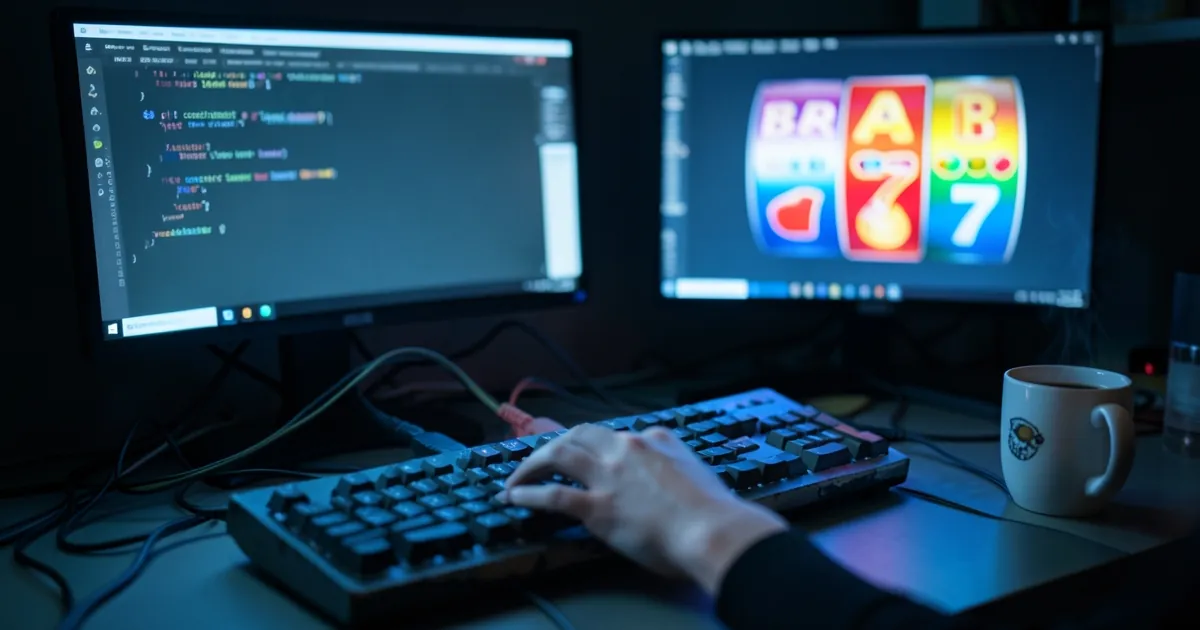
The answer is that a slot's release build is exercised on Linux in a certified test laboratory, not on the operator's production floor. Laboratories such as GLI construct independent simulations from the source code, math documentation and game rules, then run billions of simulated games to check that the realised return matches the designed RTP and satisfies each jurisdiction's requirements, according to Gaming Labs International. Linux matters in that chain because the RNG, the paytable evaluation and the game server logic are usually compiled and run there first, in a controlled and reproducible environment, before anything reaches a licensed domain. What follows is how that process actually works, where it breaks, and why the certificate you never see is the thing standing between a designed 96.2% and a shipped 94.1%.
The lab build: what Linux is actually doing in the certification chain
A slot is not one program. It is at least four: a client rendered in a browser or app, a game server that resolves spins, a random number generator that may sit inside or alongside that server, and a reporting layer that feeds the operator's platform. Certification covers the outcome-determining parts. The client is where the pretty reels live; the server is where the money is decided.
When a test house receives a submission it typically gets the game server build, the math model, the rules document, and a specification of the RNG. Linux enters here for three reasons that have nothing to do with player preference. First, reproducibility: a headless Linux image with pinned library versions produces the same execution environment for every run, which matters when you are comparing simulated outcomes across billions of spins. Second, instrumentation: the lab can attach profilers, log every RNG draw, and replay a seed deterministically. Third, isolation from the operator's stack, so that a result cannot be contaminated by a platform-side bonus engine or a wallet quirk.
The laboratory's job is not to confirm that the game is fun. It is to confirm that the game is what the documentation says it is. GLI describes its simulation work as independent — built from source code and math documentation rather than from the developer's own test harness — and that independence is the point. A developer testing its own RNG is marking its own homework, however honestly.
Why the RNG gets its own test regime
The GLI-11 gaming device standard requires the random number generator and the selection process to be impervious to electromagnetic, electrostatic and radio frequency interference, tested at a minimum severity of 27kV air discharge. That figure surprises people who think of RNG testing as a statistics exercise. It is also a hardware and environmental one: a physical terminal in a Croatian arcade on the Adriatic coast in August is not the same electrical environment as a rack in a data centre, and the standard is written for both.
On the software side, the statistical battery is the familiar one — uniformity across the output space, absence of serial correlation, no exploitable seeding patterns, and behaviour under reseeding and restart. What the lab is hunting for is not a biased die in the obvious sense. It is the subtle case: a shuffle routine that degrades after 4 billion draws because a counter wraps, or a seeding path that collides when two sessions initialise within the same millisecond. Those are the bugs that pay out wrongly for three weeks before anyone notices.
Simulation volume and what "billions of spins" buys you
Running billions of simulated games sounds like overkill until you do the arithmetic on variance. A game with a 96.5% RTP and high volatility can produce sample means that wander by whole percentage points over a few million spins. The volume is there to tighten the confidence interval to the point where a 0.3-point deviation from the designed RTP is a finding rather than noise.
This is also where the lab's simulation diverges from anything a player experiences. A player's sample is a few hundred spins on a Tuesday night; the lab's is a population-scale run. It is why the RTP figure on a help page and the RTP a player feels are two different quantities — a gap we have written about before in the RTP number most players skip before their first spin. The lab certifies the long-run number. Nobody certifies the Tuesday.
Electromagnetic, environmental and platform testing
The 27kV air discharge requirement sits in a standard originally written with cabinets and terminals in mind, and it still shapes how games are qualified for land-based and hybrid deployments. For pure online builds the equivalent concerns are different but not absent: power loss mid-spin, forced process termination, clock changes, and the behaviour of the game server when the wallet call times out.
A well-run Linux test cycle will include fault injection as a matter of course. What happens if the RNG returns a valid outcome and the wallet write fails? Does the spin void, replay, or double-charge? What happens if the server clock jumps backwards during a free-spin sequence with a persistent state? These are not glamorous tests, but they are the ones that generate player complaints and regulatory findings.
There is a version of this problem that surfaces on the player's side rather than the server's, and it is worth naming because it is measurable: interface state that behaves unpredictably at the edges. Our earlier look at lobby filters that reset on back-navigation and force a full reload is a client-side cousin of the same discipline — state that should persist, and doesn't. Labs test the money path; nobody tests the lobby path, which is why it breaks.
Certification is bound to a build, and that is the hard part
The single most consequential fact about slot certification is this: under the GLI-19 standard, certification is tied to a specific build of the game. Any later change to the paytable, the feature logic, or the RNG implementation invalidates the certificate and requires re-testing. That is per SIQ Gaming Labs.
Read that again in operational terms. A one-line change to a scatter trigger probability is not a patch. It is a new game, legally, and it cannot go live until it has been through the cycle again. Studios plan their roadmaps around this. A "minor" balance tweak scheduled for a Friday release is, in compliance terms, a submission.
This is why you see so many slots shipping with the same math model under a reskin. Reusing a certified engine and changing only art and sound is dramatically cheaper than touching the paytable, and it explains a large share of what looks like creative laziness in the market. It is not laziness. It is the certificate.
The twelve-month clock
Certification is not permanent either. Under Sweden's SIFS 2022:3, control, testing and certification protocols must be renewed at least every twelve months, and a material change to the gambling system requires a fresh assessment before release. Annual renewal means the lab re-examines a game that has already been live for a year — which is precisely when the accumulated small changes that someone forgot to declare tend to surface.
For operators running multi-market portfolios, this creates a staggered calendar of renewals and re-submissions that has to be tracked per game, per market, per build hash. It is unglamorous compliance work, and it is where licence conditions are most often breached by accident rather than design.
Who is allowed to do the testing
Not every laboratory counts. The UK Gambling Commission requires test houses to hold full accreditation to ISO/IEC 17025, and its list published on 2 March 2026 is the operative reference for licensees choosing a laboratory. That date matters: the list is a living document, and a lab that was acceptable two years ago may not be on the current version.
Accreditation to ISO/IEC 17025 is about the lab's own quality management system — its calibration, its documentation, its traceability — not just its ability to run a simulation. In practice this is what separates a genuine test house from a consultancy that will happily write you a letter.
Jurisdictions also differ on whether a lab certificate is sufficient or whether the regulator itself must approve. Ontario's Registrar's Standards for Internet Gaming, standard 4.08, amended in April 2023, requires every igaming game, random number generator and outcome-determining component to be approved by the Registrar or certified by a registered independent testing laboratory before being provided on a gaming site. Note the "or": some markets accept the lab's word, others want their own stamp on it.
For a Croatian-facing operator the practical question is which certificates travel. A game certified for one EU market is not automatically deployable in another, and the paperwork an operator needs to hold is the certificate that names the specific build, issued by an accredited lab, valid for the market in question.
What the certificate does not cover
Here is where the process gets interesting for anyone who reads help pages for a living. Certification validates the game's math against its documentation. It does not validate the operator's presentation of that math, and it certainly does not validate the player's understanding of it.
A certified 96.4% game can be presented in a lobby in ways that make it look like a 97.5% game, and nothing in the certification chain catches that. Tooltips that load slowly, RTP figures that appear after the player has already committed, filters that sort by a metric the player misreads — these are UX failures sitting downstream of a perfectly valid certificate. We looked at one measurement of that gap: RTP tooltips arriving 3.2 seconds after the interface suggests they should, and what that delay does to a decision already in motion. And separately, how little time RTP pages actually hold attention before players go looking for a licence.
The certificate also says nothing about whether the game is worth playing at the stake you have chosen. A certified high-variance slot at 96.1% will still eat a 200-spin session at minimum stake more often than not, and no laboratory is going to tell you otherwise. That is a bankroll question, and the answer is the boring one: fixed stakes, defined session limits, and a deposit cap you set before you open the lobby. Responsible gambling tools are not a legal appendix to this process — they are the only part of it that operates in your interest rather than the operator's.
The open question: does certification scale to how games actually ship?
The certification model was built for a world where a game was a fixed artefact, released once, and changed rarely. Modern slots are live products: balance patches, seasonal feature variants, A/B-tested paytables, remote configuration of bet limits and feature triggers. Each of those is a potential material change, and each one, read strictly, is a re-submission.
The regulators know this. The twelve-month renewal cycle in Sweden and the build-bound certificate under GLI-19 are both attempts to keep the paperwork attached to reality. But there is a widening gap between how fast a studio can change a live game and how fast a lab can re-certify it, and that gap is currently being managed with judgement calls about what counts as "material."
Which raises the question worth watching over the next couple of years: as remote configuration spreads, will certification move from approving a build to approving a change process — and if it does, who audits the changes the studio decides not to declare? The 27kV discharge test has a clear pass mark. "Material" does not.