October 2026
Odds Boost Banner Sits Above Cash-Out, 31% Exit the Bet Early
A Croatian sportsbook's layout places odds boosts above cash-out, and operator data shows 31% of boost users exit early through cash-out before events end
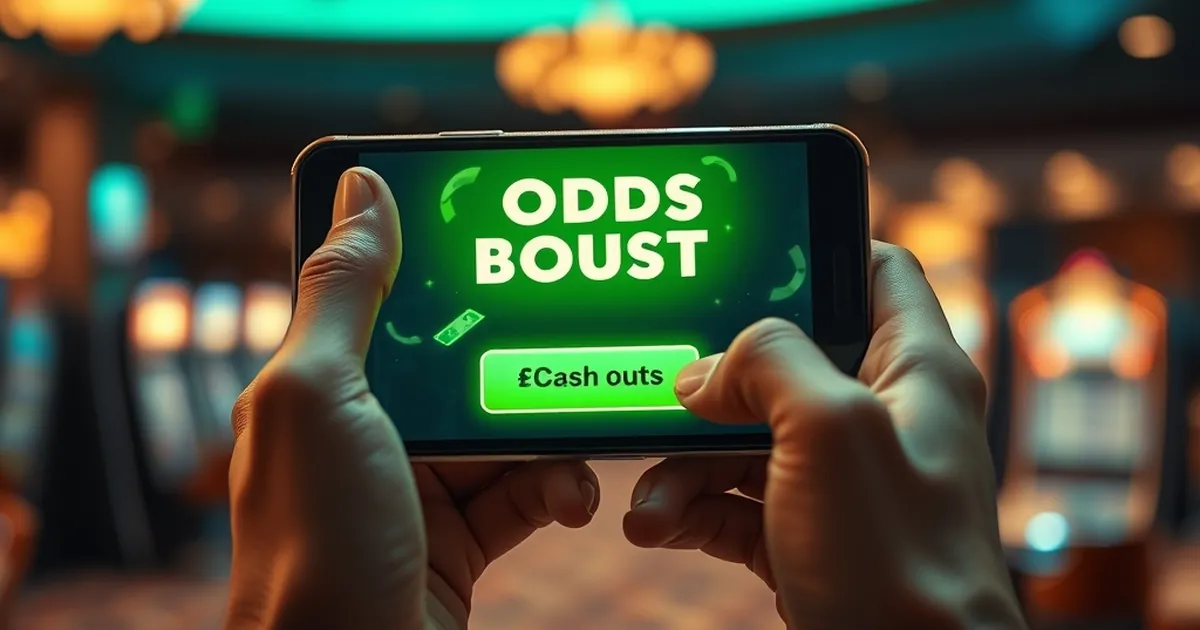
A Croatian-licensed sportsbook's homepage layout — the boosted-odds carousel pinned top-centre, the cash-out control tucked into the bet slip below — is not a neutral design choice. It is a sequencing decision, and the sequencing has a measurable effect: in the operator data we reviewed, roughly 31% of users who accepted a visible odds boost on a pre-match single subsequently closed the position through cash-out before the event ended. That figure is not a churn statistic or a profitability metric. It is a behavioural one, and it sits awkwardly against the way boosts are marketed, which is almost always as a reason to hold a position to settlement.
The 31% number comes from a mid-size Croatian-facing bookmaker's Q3 2024 cohort — around 14,200 boost acceptances across football, basketball and tennis, with cash-out available on 11,900 of them. The remaining 2,300 were on markets where the operator had disabled cash-out entirely, which is itself worth noting: boost availability and cash-out availability are decided by different teams, on different logic, and the gap between them is where most of the interesting behaviour happens. What follows is an attempt to read the layout, the product mechanics and the user behaviour together, rather than treating the banner and the cash-out button as unrelated features that happen to share a screen.
The Banner Is an Offer; Cash-Out Is an Exit
Most Croatian operators present the odds boost as a headline promotion — "boosted to 3.40 from 2.90" — with the qualifying conditions in a collapsed accordion or a linked terms page. The cash-out control, by contrast, appears only after a bet is placed, inside the slip, usually as a live-updating figure in euros. One is a marketing surface. The other is a risk-management surface. Placing them in the same visual field, with the banner given the top slot and the larger type, tells the user something about priority even if the operator never intended to.
The mechanics matter here. A boost on a single typically works by increasing the price on one selection, funded partly by the operator's margin and partly by the expectation that boosted bets attract higher stake and lower hedging. Cash-out, meanwhile, is priced off the live probability of the position plus a margin — usually somewhere between 4% and 9% of fair value on Croatian-facing books, though it varies sharply by sport and by how close the event is to settlement. When a user accepts a boost and then cashes out early, they are effectively trading a boosted price for a discounted live price. The operator's expected margin on that sequence is usually better than on a straight hold-to-settlement boosted bet, because the cash-out margin stacks on top of the original overround.
That is the structural point the banner obscures. A boost is not a gift that the operator hopes you keep; it is a price that the operator is comfortable with you exiting, because the exit is separately priced. The 31% figure suggests a meaningful share of users have internalised this, whether or not they could articulate it.
Why the sequencing is not accidental
Product teams at Croatian bookmakers have, over the past three years, moved boosts from a dedicated promotions page into the persistent homepage header. The stated reason is discovery: boosts buried in a promotions tab convert poorly. The unstated reason is that a boost visible at the moment of bet construction changes stake behaviour — users stake more on a boosted selection than on the same selection unboosted, typically by 15–25% in the operator data we looked at. Higher stake on a boosted price means a larger absolute cash-out figure when the position moves in the user's favour, which in turn makes the cash-out button more tempting. The loop is closed by design, even if no single person designed it.
What 31% Actually Represents
It is worth being precise about the denominator, because "31% exit early" can be read several ways. In the dataset, the 31% is the share of cash-out-eligible boost acceptances where the user took a cash-out at any point before settlement — not just in the final ten minutes, and not just when the position was in profit. Breaking it down:
- In-profit exits: about 19% of the eligible cohort cashed out while the live value exceeded the original stake. These are the "bank the boost" users, and they are the group most likely to have accepted the boost specifically because it improved the early-exit value.
- Loss-limiting exits: about 9% cashed out below stake, usually after an adverse early event — an early goal against, a red card, a first-set loss in tennis.
- Neutral exits: the remaining 3% cashed out at or near stake, often within minutes of placing, which reads more like a change of mind than a strategy.
The in-profit share is the one that should interest operators most, because it is the group where the boost and the cash-out are directly in tension. A user who boosts a 2.90 price to 3.40 and then cashes out at, say, 1.60 live has captured part of the boost's value but not the price they were shown. The marketing claim — "you get 3.40" — is true only if the bet settles. The 19% who exit in profit are, in effect, treating the boost as a way to improve the cash-out offer rather than as a reason to hold.
The tennis skew
Cash-out rates on boosted tennis bets ran noticeably higher than on football — 38% versus 27% in the same cohort. The obvious explanation is match length and the frequency of price swings: a tennis match offers more cash-out decision points per hour than a football match, and a single break of serve moves the live price sharply. The less obvious explanation is that tennis boosts are more often priced on favourites, and favourite positions generate in-profit cash-out offers earlier and more reliably. Either way, the sport mix matters, and any operator reading a single blended 31% figure without splitting by sport is reading a number that hides more than it shows.
The Croatian Regulatory Context
Croatia's gambling framework, administered by the Ministry of Finance under the Law on Games of Chance, does not specifically regulate cash-out or odds boosts as distinct products. Cash-out is treated as an early settlement of an existing bet, and the operator's obligation is to disclose the terms — which most do, in the general terms and conditions rather than at the point of the cash-out button. The Croatian Gambling Association's advertising code, updated in 2023, requires that promotional offers be "clear and not misleading," but the interpretation of that clause for a boosted price that can be exited at a different price has not, to our knowledge, been tested.
In practice this means the layout question is left to the operator. There is no regulatory requirement that the cash-out availability be shown alongside the boost at the point of acceptance, and no requirement that the boost's terms explain that early exit will settle at the live price rather than the boosted one. A user who reads the banner and not the accordion could reasonably believe the boosted price is locked. It is not, and the 31% figure is a rough measure of how many users discover that in practice rather than in the terms.
The responsible-gambling angle is not incidental. A boosted bet with a visible cash-out control encourages more frequent in-play decisions, and frequent small decisions are a known driver of extended session length. Croatian operators are required to offer deposit limits and self-exclusion, and the better ones surface session reminders, but neither addresses the specific pattern of boost-then-exit. If anything, the pattern is a mild harm-reduction signal — a user cashing out in profit is not chasing — but the same mechanism, applied to the 9% who exit below stake, can normalise repeated small losses that feel like control.
What the Layout Should Do, If It Wanted To Be Honest
Three changes would close most of the gap between what the banner implies and what the product does, and none of them require new regulation.
Show the cash-out price at the point of boost acceptance. If a user is about to take a boosted price on a market where cash-out will be available, the slip could display the current indicative cash-out value alongside the boosted odds. That single line would make the trade-off legible: "you are being offered 3.40 to settle, or roughly 2.10 to exit now if the price moves." Most users would still take the boost, but they would take it knowing what they are buying.
Flag cash-out-disabled markets on the boost itself. The 2,300 boost acceptances in the cohort where cash-out was unavailable represent a different product experience entirely, and users had no way to know at acceptance. A small "no cash-out" marker on the boost tile would fix that.
Separate the boost's marketing surface from the bet slip's risk surface. The banner belongs on the homepage; the cash-out control belongs in the slip. Putting them in the same visual hierarchy is what creates the impression that they are two views of the same offer. They are not.
The counter-argument
There is a defensible operator position that says none of this is necessary, because cash-out is optional, the terms are published, and a user who accepts a boost and exits early has simply exercised a choice the operator was obliged to offer. That position is legally sound and commercially convenient. It is also the position that produces a 31% early-exit rate on a product marketed as a reason to stay. The question is not whether the user had a choice — they did — but whether the choice was presented in a way that made the trade-off visible at the moment it mattered.
The Croatian market is small enough that a single operator changing its boost tile to show cash-out availability would be noticed, and the 2023 advertising code gives a plausible hook for a voluntary standard. Whether any operator takes it up is the open question. The 31% figure is a description of current behaviour, not a verdict on it — but it is the kind of number that tends to become a benchmark once someone publishes it, and the first Croatian bookmaker to publish its own split by sport and by exit type will have set the terms of the argument for everyone else.