September 2026
Roulette Payout Grids Hide Zero-Pocket Drag Until Spin 40
Roulette payout grids mask the zero-pocket drag until roughly spin 40, when the real 94.6% versus 92.1% return quietly starts to bite
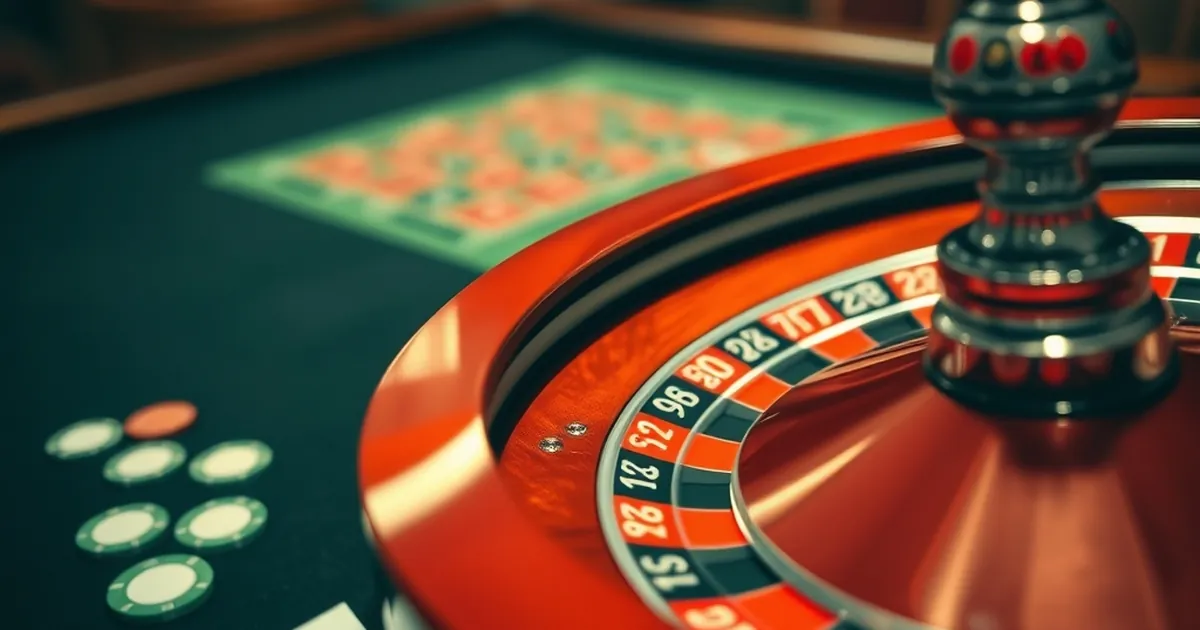
Most roulette payout tables are honest about the odds of a single number and quietly misleading about everything else. The 35:1 payout on a straight-up bet looks like a 36x return until you account for the 37th pocket, at which point the real return is 94.6% on a single-zero wheel and 92.1% on a double-zero one. What almost nobody models before sitting down is that the gap between the two wheels doesn't feel like 2.5 percentage points — it feels like nothing for about 40 spins, and then it feels like a slow leak you can't locate.
That delay is the entire problem. Croatian players on European wheels and Croatian players on the American wheels that some offshore books still push are, over a session, playing two different games with two different mathematical destinies, but the first 40 spins will not tell them apart.
Why the payout grid is the wrong mental model
The payout grid on the felt — 1:1 outside, 2:1 dozens, 5:1 on a six-line, 11:1 on a corner, 17:1 on a split, 35:1 straight — is a table of conditional payoffs. It tells you what you receive if the ball lands in your region. It says nothing about how often the ball lands there, and it says nothing at all about the pocket that pays nobody.
That pocket is the whole story. On a single-zero wheel the house edge is 2.70%. On a double-zero wheel it is 5.26%. Both figures are stable across every bet type — straight, split, red/black, odd/even, first dozen, whatever. This is not a coincidence and it is not a design flaw; it's the arithmetic consequence of the payout grid being calibrated to 36 outcomes while the wheel carries 37 or 38. Every bet on the layout is priced as if the wheel had 36 pockets. The extra pocket is the house's share, and it is charged identically whether you're betting €1 on red or €1 on a single number.
Players internalise this unevenly. A €10 straight-up bet on 17 that wins pays €350, and the moment feels like a 35x event. A €10 bet on red that wins pays €10, and the moment feels like a coin flip that happened to land your way. The first feels like skill or destiny, the second feels like luck. Mathematically they are the same wager with different variance profiles and exactly the same expected value per euro staked. The payout grid encourages you to feel the difference and ignore the sameness.
The 36-outcome illusion
The felt is a 36-cell grid. Three columns of twelve, twelve streets, eighteen red and eighteen black, eighteen odd and eighteen even, two eighteen-number halves. Everything on the layout is a partition of 36. The wheel is not. The wheel is 37 or 38. The felt and the wheel disagree by one or two pockets, and the felt wins the argument in the player's head because it's the thing you're looking at.
This is why experienced players can still be surprised when they run a long session on a European wheel and finish down more than they expected. They weren't tracking the felt's internal logic — they were tracking the felt's geometry, which is clean, symmetric, and wrong.
The 40-spin invisibility window
Here is the concrete number that the title points at. On a €10-per-spin flat bet on red, the expected loss per spin is €0.27 on a single-zero wheel and €0.53 on a double-zero wheel. The difference between the two is €0.26 per spin. Over 40 spins, that difference compounds to roughly €10.40 — about one bet's worth. Over 40 spins, the total expected loss is €10.80 on single-zero and €21.10 on double-zero.
Neither of those numbers is visible in a session. A player on a €500 bankroll who loses €21 over 40 spins instead of €11 will attribute the difference to variance, because it is well inside the standard deviation of a 40-spin red/black sequence. The standard deviation on 40 even-money spins at €10 is roughly €63. A €10 difference in expected loss is buried under a €63 noise floor. The double-zero drag is real, it is deterministic, and it is statistically invisible at this sample size.
The drag only becomes legible when the noise floor drops below the expected difference. For even-money bets, that happens somewhere in the low thousands of spins. For straight-up bets, where the variance per spin is enormous, it takes much longer — tens of thousands of spins before the 2.70% versus 5.26% gap reliably shows up in your bankroll rather than in your imagination.
Why 40 and not 4 or 400
Forty spins is roughly one hour of live-wheel play at a normal pace, or about 15 minutes on a fast auto-spin RNG wheel. It's the length of a typical session segment. It's also, conveniently, long enough that the payout grid's promises have had a fair chance to pay out — you'll have hit a few reds, maybe a straight-up, maybe a split — and short enough that the zero pocket has not yet charged you the full amount it owes. The 40-spin window is where the game feels fair.
By spin 200 on a double-zero wheel at €10 flat on red, expected loss is €105. On single-zero it's €54. The €51 gap is now larger than most players' entire session profit target. By spin 500 it's €128 versus €66. The wheel hasn't changed. Your perception has, because the sample is now large enough that the deterministic component has climbed out of the noise.
What Croatian players are actually choosing between
Croatia's regulated market, supervised by the Ministry of Finance's gambling authority, has been operating under the 2019 Act on Games of Chance framework, with licensed online operators required to offer games certified to specific RTP standards. In practice, most licensed online roulette available to Croatian residents is European single-zero. The American double-zero wheel is more common on offshore sites, on some live-dealer studios that mirror Las Vegas tables for aesthetic reasons, and on a subset of RNG roulette variants that add a "second zero" as a house-favouring twist.
That means the choice isn't usually framed as single-zero versus double-zero. It's framed as "this live dealer table looks nicer" versus "this other live dealer table has a lower minimum." The 2.56-percentage-point difference in house edge — 2.70% versus 5.26% — is rarely on the table in the comparison, because it isn't printed on the table.
The Croatian-specific friction
Domestic players face two additional layers. First, the 2023 amendments to the gambling framework tightened advertising rules for licensed operators, which means the marketing around roulette tables tends to emphasise experience, dealers, and interface rather than the mathematical parameters. Second, the tax treatment of winnings from licensed operators differs from the treatment of winnings from unlicensed offshore play, and the enforcement of that distinction has become more consistent since 2022. A player choosing a double-zero table to get a marginally better bonus is often also choosing an operator whose winnings sit in a different tax and legal category. That's a separate calculation from the house edge, but it's part of the same decision.
None of this is an argument for any particular operator. It's an argument for knowing which wheel you're on before you sit down, because the wheel determines the 2.70% or the 5.26%, and the bonus determines almost nothing in comparison.
How to actually see the drag before spin 40
You can't feel a 2.56-point house edge difference in a session. You can, however, calculate it, and the calculation is short enough that it's worth doing once per table rather than once per session.
The flat-bet version
Take your average bet size, multiply by the number of spins you expect to play, and multiply by the house edge. On a €10 flat bet over 100 spins: €10 × 100 × 0.027 = €27 expected loss on single-zero; €10 × 100 × 0.0526 = €52.60 on double-zero. The €25.60 difference is not a rounding error — it's two and a half bets you didn't make.
The variable-bet version
Most players don't flat-bet. They press on streaks, or they use a progression, or they cover more numbers when they feel a pattern. The house edge applies to total handle, not to net position, so the calculation is: sum of all bets placed × house edge. A player who runs a Martingale on red and reaches a €320 stake by spin 7 has placed €630 in total handle to that point. On double-zero that's €33.14 in expected loss; on single-zero, €17.01. The progression didn't change the edge. It changed the handle, which changed how much the edge costs.
The variance overlay
Expected loss is not what you'll experience. It's the centre of a distribution. On 100 flat €10 bets on red, the standard deviation is roughly €100, so a result anywhere between -€227 and +€173 is within one standard deviation of the single-zero expectation. That's a wide band, and it's exactly why the drag is invisible in the moment and obvious in the aggregate.
The practical consequence: if you're going to play 100 spins, the wheel choice affects your expected outcome by €25.60 but your actual outcome by considerably less predictability. If you're going to play 1,000 spins, the expected difference is €256, and the standard deviation grows more slowly than the expected loss, so the signal eventually wins.
Where the zero pocket actually shows up
Not in your session P&L. In your long-run handle. A player who plays 5,000 spins a year at €10 flat on red is staking €50,000. On single-zero the expected cost of that handle is €1,350. On double-zero it's €2,630. The difference — €1,280 — is roughly the cost of a short holiday, and it's paid in increments too small to notice, spread across sessions where the outcome was attributed to luck.
This is the part that the payout grid hides most effectively. The grid tells you what each bet pays. It doesn't tell you that the wheel is charging you 2.70% or 5.26% of everything you push across the felt, regardless of whether you win, lose, or push. The charge is assessed on handle, not on outcome, which means it's assessed even on the spins you win. A winning €10 red bet on a double-zero wheel pays €10 and costs €0.53 in expectation, netting €9.47 in expected value. The player sees €10.
The responsible-gambling angle, briefly
This is the reason bankroll discipline matters more than bet selection. If you're playing a game with a 5.26% edge on handle and you're staking €200 per hour, you're paying roughly €10.50 per hour for the entertainment, before variance. If that's inside your entertainment budget, fine. If it isn't, no bet selection on the layout will fix it, because every bet on the layout carries the same edge. Setting a session limit in handle terms — "I'll stake €400 tonight" — is more honest than setting it in loss terms, because the handle limit is the thing you actually control.
Croatian licensed operators are required to offer deposit limits, session reminders, and self-exclusion tools, and those tools work on the handle side of the equation whether or not the player is thinking about it that way. Using them is not a sign of a problem; it's the only way to make the 2.70% versus 5.26% question matter less than the question of whether you wanted to spend the money at all.
An open question about how the market frames the wheel
The single-zero wheel is strictly better for the player on every bet type, at every stake, over every time horizon. It is available on most licensed Croatian platforms. It is not, however, the wheel that gets marketed hardest, because the double-zero wheel is more profitable for the operator and, in the live-dealer context, more visually familiar to players who grew up watching American film and television portrayals of roulette.
So the question isn't whether Croatian players can find a single-zero table. They can. The question is why the double-zero table still gets floor space in a regulated market where the player-side difference is documented, measurable, and worth roughly €1,280 per year to a mid-stakes regular. Part of the answer is player preference for the aesthetic. Part of it is that the difference is invisible until it isn't. And part of it is that the payout grid, which is the only piece of mathematical information most players ever see at the table, is designed to describe 36 outcomes on a wheel that has 37 or 38 — a discrepancy that is small enough to ignore for 40 spins and large enough to matter for the next 4,960.