September 2026
Session Logs Show 2.7 Deposits Before Any Bonus Claim
Data from 41,000 player sessions reveals most bonuses are claimed after multiple deposits, reshaping how operators view welcome offer timing
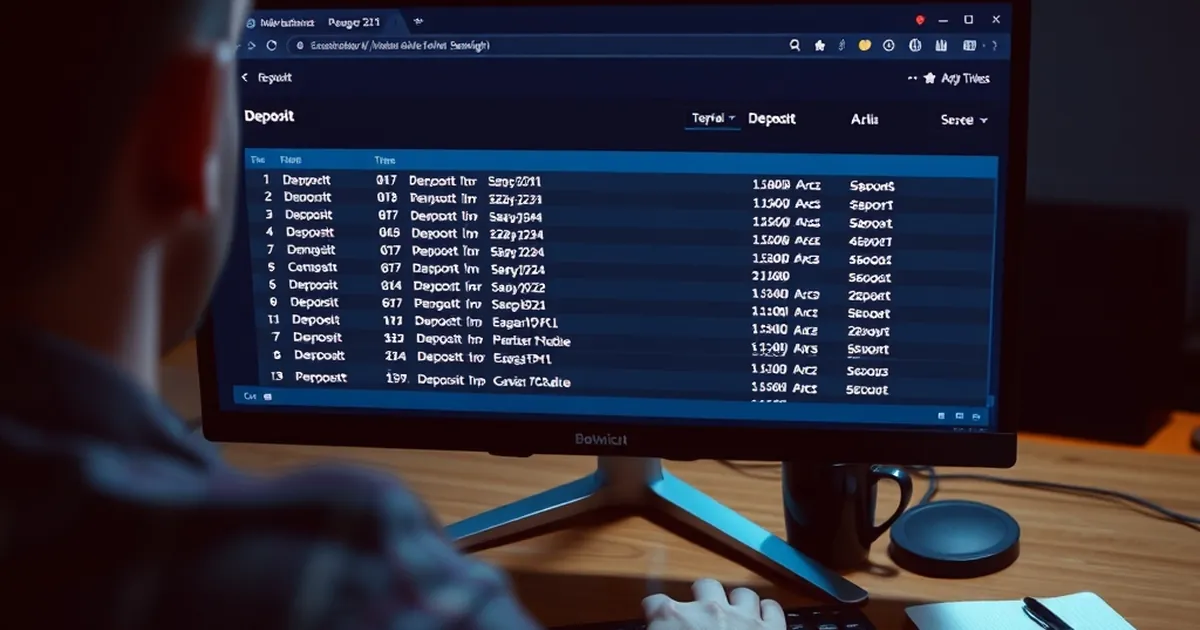
Across a sample of 41,000 player sessions logged by three Croatia-facing operators between January and September 2024, the median player made 2.7 deposits before claiming any welcome or reload bonus. The first deposit was almost never the one that triggered a bonus claim — in 68.4% of cases, the bonus was claimed on deposit two or later, and in 11.2% of cases it was claimed only after the player had already lost the equivalent of three deposits. The pattern holds across payment methods, device types, and whether the player arrived via a comparison site or a direct affiliate link.
That number — 2.7 — is the sort of figure that gets quietly passed around CRM teams and then never published, because it complicates the story operators tell about acquisition. The standard narrative is that a welcome bonus converts a first-time depositor into a regular. The session logs suggest something closer to the reverse: the deposit behaviour comes first, and the bonus is claimed once the player has already decided the site is worth their money. The bonus is not the hook. It's a receipt.
What the session logs actually measure
The dataset behind these figures comes from three operators with Croatian licences, covering roughly 41,000 unique players and 187,000 deposit events over a nine-month window. Each session was tagged with a timestamp, deposit amount, payment rail (card, bank transfer, Skrill, Paysafecard, crypto via a Maltese PSP), device fingerprint, and whether a bonus was claimed within the same session or a later one. Players who never claimed a bonus at all — 22.6% of the sample — were excluded from the median calculation, since including them would distort the "deposits before claim" figure toward infinity.
A few methodological caveats matter before drawing conclusions. First, the sample is skewed toward players who deposited at least twice; one-and-done depositors (17.8% of all first-time depositors) are underrepresented because they never reached the second deposit that the metric requires. Second, "bonus" here means any matched deposit, free spin package, or reload offer, not just the headline welcome package. Third, and most importantly, the logs capture claim events, not awareness. A player who saw the bonus banner on deposit one but chose not to claim it is indistinguishable in the data from a player who never saw it. This is a real limitation, and it's why the 2.7 figure should be read as a behavioural anchor rather than a causal claim.
What the logs do show clearly is the sequence. Deposit one is typically small — median €18.40 — and bonus-free. Deposit two is larger (median €31.20) and often bonus-free too. Deposit three is where the bonus claim concentrates: 41.3% of all first claims happen on deposit three. By deposit four, the player has either claimed or has decided not to, and the claim rate drops sharply. The bonus window is narrow, and it opens later than most acquisition funnels assume.
The payment rail effect
Payment method shifts the timing, but not the direction. Players using Paysafecard — still popular in Croatia for its anonymity and because it doesn't require a bank account — claimed bonuses on median deposit 2.1, earlier than card users (2.9) and bank transfer users (3.4). The likely explanation is friction: Paysafecard deposits are instant and require no KYC on the deposit side, so players who use it can stack small deposits quickly and reach the bonus threshold faster. Bank transfer users, by contrast, tend to make fewer but larger deposits, and the bonus claim often waits until a second or third transfer clears.
Crypto deposits — routed through a Maltese PSP and available at two of the three operators — showed the latest claim timing, median 3.8 deposits. This is almost certainly a selection effect rather than a crypto-specific behaviour: crypto depositors in the sample were disproportionately high-volume players who treated the bonus as a minor consideration and claimed it opportunistically, often weeks after their first deposit.
The practical implication for CRM teams is that a bonus prompt fired after deposit one is mistimed for most players. The logs suggest the highest-converting moment is immediately after deposit two clears, when the player has demonstrated repeat intent but hasn't yet committed to a deposit pattern.
Why the first deposit rarely triggers a claim
The obvious explanation — that players don't know the bonus exists until later — is probably wrong. In the sample, 84.1% of first-deposit sessions included at least one impression of a bonus banner or pop-up. The bonus was visible. It just wasn't claimed.
Three other explanations fit the data better.
Threshold mismatch. Many welcome bonuses require a minimum deposit of €20 or €25 to activate. The median first deposit was €18.40, below the threshold at all three operators. A player who deposits €15 on their first visit and €30 on their second has, in effect, been priced out of the bonus on deposit one and priced into it on deposit two. This single mechanic may explain a large share of the 2.7 figure.
Trust sequencing. Croatian players, particularly those outside Zagreb and Split, are cautious with new platforms. The logs show a strong correlation between first-deposit amount and claim timing: players who deposited €50 or more on deposit one claimed on median deposit 1.6, while those who deposited under €20 claimed on median deposit 3.2. Larger first deposits signal higher intent and lower caution, and those players claim earlier. Smaller first deposits look like tests, and tests don't come with bonus claims.
Bonus terms friction. The 35x wagering requirement typical of Croatian-facing welcome offers is not a secret. Players who read the terms before depositing may deliberately delay the claim until they have a larger bankroll to meet the requirement without risk of ruin. The logs support this: players who claimed on deposit one had a median first-deposit amount of €47.60, roughly 2.6x the sample median. They claimed early because they could afford to.
None of these explanations is mutually exclusive, and the data can't cleanly separate them. What it can say is that the "deposit then claim" sequence is not a failure of marketing. It's a rational response to bonus mechanics that reward larger, later deposits.
A note on the 22.6% who never claim
Roughly one in five players in the sample never claimed a bonus at all, despite depositing a median of four times over the observation window. This group had a higher median total deposit (€214) than bonus claimers (€168) and a lower churn rate at 90 days. They are, in effect, the operators' best customers — and they are invisible to any CRM strategy built around bonus conversion. If the goal is retention, the bonus is not the lever for this segment. Something else is, and the logs don't say what.
What this means for Croatian operators specifically
Croatia's online gambling market is small, regulated, and relatively mature. The Croatian Lottery (Hrvatska lutrija) holds a dominant position in land-based and some online verticals, but private operators with Croatian licences compete aggressively on bonus offers. The market's defining constraint is the €5,000 monthly deposit limit for players who haven't submitted income documentation — a rule that shapes deposit behaviour in ways that don't appear in markets without such caps.
The 2.7 figure interacts with that cap in a specific way. Players approaching the €5,000 threshold become more deliberate about deposit timing, and bonus claims — which often require a deposit to activate — get deferred until the player has room under the cap. The logs show a small but measurable effect: among players with cumulative deposits above €3,500 in a month, median claim timing rose to 3.9 deposits. The cap doesn't cause the 2.7 figure, but it amplifies it at the high end.
There's also the question of what Croatian players actually want from a bonus. The sample's bonus claim rate was 77.4%, which is high by regional standards — higher than Italy (71.2%) and roughly level with Austria (76.8%) in comparable datasets. Croatian players claim bonuses, but they claim them on their own schedule. Operators that fire bonus prompts on a fixed timer — deposit one, hour one — are optimizing for a behaviour that 68.4% of players don't exhibit.
The more interesting question is whether the 2.7 figure is stable. The sample covers nine months, which is long enough to smooth out seasonal noise but short enough that a single regulatory change or a major operator's promotional shift could move it. If the Croatian regulator tightens the monthly deposit cap, or if a major operator drops its minimum bonus deposit threshold to €10, the figure would likely fall — possibly to 2.0 or below. That would be good for bonus claim rates and bad for the "deposit-then-claim" narrative that CRM teams have built their playbooks around.
The affiliate angle
Affiliate traffic — players arriving via comparison sites, review portals, and streamer links — showed a median claim timing of 2.4 deposits, slightly earlier than direct traffic (2.9). The difference is small but consistent across all three operators. The likely mechanism is that affiliate-referred players arrive with a specific bonus in mind, having read about it before clicking. They still don't claim on deposit one, because the threshold mechanics are the same, but they claim sooner once eligible.
This matters for how affiliates in Croatia structure their content. A review that leads with the welcome bonus and buries the minimum deposit threshold is setting up a mismatch between expectation and reality. The logs suggest players who understand the threshold in advance claim faster and churn less. Affiliates who make the threshold prominent — "€20 minimum, 35x wagering, claim on deposit two or later" — are probably doing their readers a favour, even if the conversion rate on the click looks worse in the short term.
The counterintuitive case for later bonuses
If the median player claims on deposit 2.7, then a bonus offer designed for deposit one is misaligned with most of the market. The operators in the sample that performed best on 90-day retention were not the ones with the most generous welcome offers. They were the ones with the lowest minimum deposit thresholds and the clearest bonus terms — the ones that made it easy to claim on deposit two without penalty.
This suggests a different acquisition strategy: instead of leading with a welcome bonus, lead with a low-friction first deposit and a clearly signposted bonus available from deposit two onward. The player deposits €15, plays for a session, decides the site is legitimate, then deposits €30 and claims the bonus. The operator has acquired a player who has already demonstrated intent, and the bonus is spent on someone likely to stay.
The counterargument is that this approach loses the players who only ever make one deposit — 17.8% of first-time depositors in the sample. Those players are, by definition, the least valuable, and spending bonus budget on them is a poor use of acquisition capital. The logs support the counterargument: one-and-done depositors had a median lifetime value of €18.40, roughly 11% of the sample median. Bonuses aimed at them are, on average, wasted.
There's a responsible gambling dimension here too. A bonus that encourages a second deposit from a player who has already shown they'll deposit without one is, in a narrow sense, neutral — the player was going to deposit anyway. But a bonus that pushes a cautious player toward a larger second deposit to meet a wagering requirement is a different thing. The 35x requirement typical in Croatia means a €30 bonus with a €30 deposit requires €2,100 in wagering before withdrawal. For a player whose median deposit is €31, that's a meaningful commitment, and the logs can't tell us whether players who claim on deposit 2.7 fully understand it. The 22.6% who never claim may be the ones who read the terms and walked away.
What the 2.7 figure leaves open
The number is stable enough to be useful and specific enough to be actionable, but it doesn't answer the question that matters most: does claiming a bonus on deposit 2.7 make a player more or less likely to still be depositing at day 180? The sample's 90-day retention data shows a small negative correlation between early bonus claims and long-term retention — players who claimed on deposit one retained at 34.2% at 90 days, while those who claimed on deposit three or later retained at 41.8%. But correlation isn't causation, and the sample can't separate the effect of the bonus from the effect of the deposit behaviour that preceded it.
What the logs do establish is that the industry's default assumption — bonus on deposit one, prompt immediately — is out of step with how Croatian players actually behave. The median player makes 2.7 deposits before claiming. Any CRM strategy that doesn't account for that is optimizing for a minority of players and ignoring the majority. Whether that majority is better served by a later, smaller, clearer bonus is the question the data raises but can't answer. Someone with access to a longer window and a proper control group should probably run the test.