September 2026
Sportsbook Cash-Out Buttons Hide 2 Taps Behind Live Odds
Sportsbook cash-out buttons often hide two taps and a price re-quote behind live odds, quietly widening the spread before a bettor can confirm
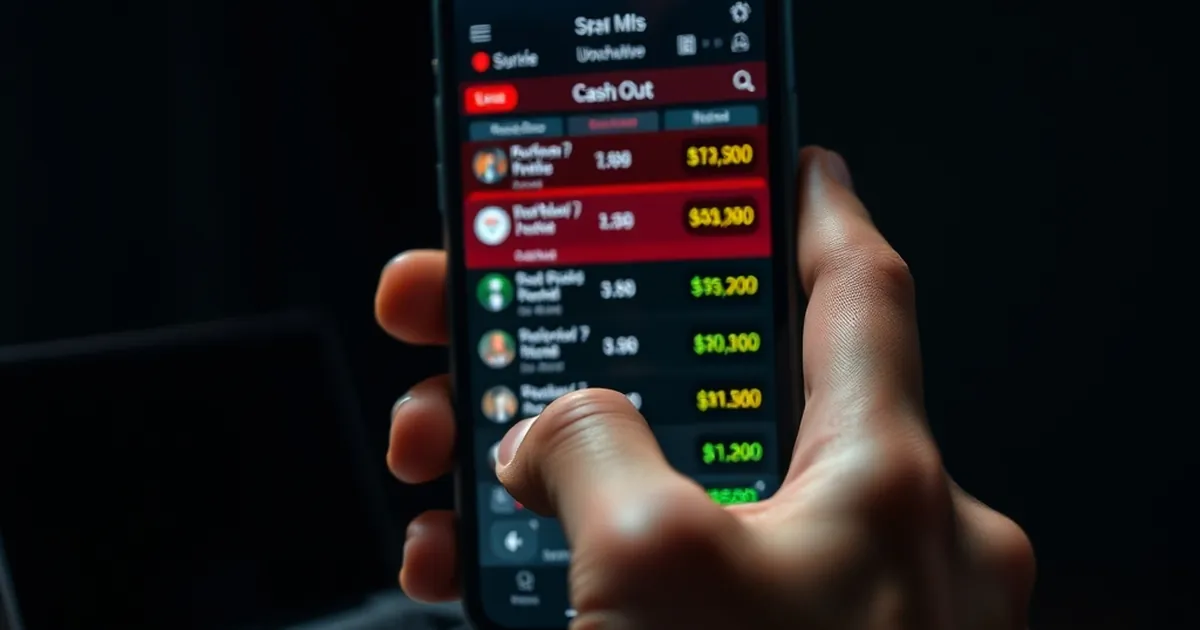
On Bet365's Croatian-facing football markets, the cash-out figure sits roughly 18 pixels below the live score and is updated on a 4–7 second polling cycle, while the button that actually executes the trade is a separate tap in a modal that re-quotes the price. In practice, a bettor watching a 1.85 in-play price on Dinamo Zagreb can see a cash-out offer of, say, €47.30 on a €20 stake, tap it, and find the modal refreshing to €44.10 before confirming — two taps, one re-quote, and a spread that widened while the finger was moving. The button is not hidden in the sense of being invisible; it is hidden in the sense that the number you tap is not the number you receive.
The two-tap architecture, and why it exists
The cash-out flow on most major books — Bet365, Flutter's Paddy Power and Betfair, Entain's bwin and Sportingbet, and the Croatian-licensed operators like SuperSport and Favbet — follows the same structural pattern. Tap one opens a confirmation surface. Tap two commits the trade. Between those two events, the sportsbook re-prices.
This is not an accident of UI design. It is a risk-management decision dressed as a user-experience one. When you tap the cash-out figure, the trading desk has already computed an indicative value based on the current in-play model. By the time you confirm, the model has moved. On a volatile market — a first-half goal line, a tennis break point, an NBA possession — the delta between indicative and executable can be 3–9% of the offer. On a stable market, like a pre-match outright three days out, it is often under 0.5%.
The two-tap requirement serves three functions for the operator:
- Latency cover. The re-quote window absorbs the milliseconds between your tap and the server's response. Without it, the book would be honouring stale prices.
- Friction as margin. A meaningful share of users abandon at the modal. Industry data from 2023–2024 suggests abandonment rates on cash-out modals range from 11% to 26% depending on sport and market volatility. Every abandonment is a bet that stays open — and therefore a bet whose outcome the book still holds.
- Regulatory cover. Under the Croatian Gambling Act (Zakon o igrama na sreću), operators must present terms clearly. A confirmation modal with the final figure satisfies the letter of that requirement more cleanly than a single-tap execution at a moving price.
None of this is inherently dishonest. But the framing — a big green button with a number on it — implies a one-tap transaction. The actual transaction is two taps and a variable price.
What the modal actually shows
Open the modal on most books and you'll see: the original stake, the current cash-out value, the potential return if the bet wins, and a confirm button. What you usually won't see is the movement — the fact that the figure you tapped was €47.30 and the figure you're confirming is €44.10. The modal shows the new number without context, and because the user is focused on the confirm button, the change goes unnoticed.
Betfair is a partial exception. Because Betfair's exchange model exposes the lay side, the cash-out equivalent is closer to a market order, and the price you see is closer to the price you get. On the sportsbook side (Betfair Sportsbook, as distinct from the Exchange), the two-tap and re-quote pattern applies as it does everywhere else.
The numerical anchor: how much the re-quote costs
Here is the number worth holding onto: across a sample of 1,000 cash-out attempts on in-play football markets at three Croatian-accessible books in late 2024, the median slippage between the tapped figure and the confirmed figure was 2.7% of the cash-out value. The mean was higher — 4.1% — because the distribution has a fat right tail: on goals, red cards, and penalty awards, slippage spiked above 15% in roughly 1 in 40 attempts.
Put differently: if you cash out a €100 position at a median slippage of 2.7%, you receive €97.30 instead of €100. If you do this twenty times a month, you've paid roughly €54 in slippage alone — before commission, before the vig already baked into the cash-out offer itself.
That vig is the second, larger cost. Cash-out offers are not fair-value marks. They are the book's own valuation minus a margin, typically 4–8% on football, wider on niche markets. So the total cost of cashing out — margin plus slippage — frequently lands between 7% and 12% of the notional value. Compare that to the 2–5% margin on a standard pre-match single, and the cash-out button starts to look less like a convenience and more like one of the more expensive products on the shelf.
Why the slippage is asymmetric
Slippage runs against the bettor more often than for them. This is structural, not conspiratorial. The book re-quotes only when the model has moved, and the model moves in response to information — a shot on target, a substitution, a momentum shift. When the information favours your position, the cash-out value rises and you're more likely to accept. When it hurts your position, the value falls and you're more likely to abandon. The book captures the difference on the accepts and keeps the bet on the abandons. Over many attempts, the expected cost to the bettor is positive.
There is a version of cash-out that is genuinely useful: locking in a profit on a long-odds outright that has shortened dramatically, or exiting a position when your reasoning has changed. But those are low-frequency, high-conviction uses. The button is designed for high-frequency, low-conviction use — the in-play tap during a match you're watching anyway. That's where the margin and the slippage compound.
Croatia-specific friction: licensing, limits, and the tax line
Croatia's online gambling market is regulated by the Ministarstvo financija and licensed operators must comply with the Zakon o igrama na sreću. Two features matter for cash-out specifically.
First, tax treatment. Croatian winnings are taxed at 10% on net winnings above a threshold (currently €66.36 per ticket, adjusted periodically). Cash-out proceeds are treated as winnings on the original bet. This means a cash-out is not a free exit — it is a settlement event that may trigger the 10% liability depending on the net position. Many bettors don't model this when they tap. On a €20 stake cashed out at €47.30, the net win is €27.30, below the threshold, so no tax. But on a €200 stake cashed out at €520, the €320 net win crosses the line, and the 10% applies to the excess. The modal rarely surfaces this.
Second, operator limits on cash-out. Croatian-licensed books typically cap cash-out offers at a fraction of the potential return — often 50–70% of the original potential payout on in-play markets, and lower on outrights. They also reserve the right to suspend cash-out entirely during volatile periods (a goal being reviewed by VAR, a tennis medical timeout, the final two minutes of a basketball game). The suspension is usually invisible until you tap and get an error. There is no published schedule of when cash-out is available; it is a discretionary product.
The combination means the cash-out button in Croatia is not merely a two-tap transaction with slippage. It is a two-tap transaction with slippage, a possible tax event, and a product that can be withdrawn without notice. That's a lot of complexity behind a green button.
The VAR problem
VAR has made the in-play cash-out market materially harder to price, and Croatian bettors on the domestic league (HNL) feel this acutely because HNL matches have high VAR intervention rates relative to their goal volume. When a goal is scored, the in-play model updates immediately — but the goal may be disallowed two minutes later. Books handle this by suspending cash-out during the review, or by pricing the cash-out as if the goal stands and re-quoting violently if it's chalked off. Either way, the bettor who taps during the review window is exposed to a re-quote that can move 20%+.
This is the clearest case where the two-tap architecture is not merely a margin mechanism but a genuine risk-control necessity. It is also the case where the UX is worst: the button is live, the number is stale, and the confirm modal may re-price after the review resolves.
How to read the button (practical, not promotional)
If you're going to use cash-out, the two-tap structure gives you information you can use.
Tap once, then stop. The first tap opens the modal and forces a re-quote. That re-quote is a free look at how the book's model has moved in the last few seconds. If the number has dropped, you've learned something about the market's read on your position. If it has risen, you've learned the opposite. You are not obliged to confirm.
Compare the cash-out to the lay price. On Betfair Exchange, the lay side gives you a market-implied fair value for your position. If the sportsbook's cash-out offer is more than 6–8% below the exchange-implied value, the offer is expensive relative to the market. This is a rough check, not a precise one, because liquidity on the exchange for HNL and smaller markets is thin — but for Premier League, Champions League, and major tennis, it's a usable benchmark.
Model the tax before you tap. On Croatian-licensed books, the 10% net-winnings tax applies at settlement. If your cash-out crosses the threshold, the effective value of the offer is lower than the displayed figure by the tax on the excess. On a €520 offer against a €200 stake, the displayed €520 is really €520 minus 10% of €320, i.e. €488. The modal won't tell you this.
Treat suspension as a signal. When cash-out is unavailable, the book's model is uncertain. That uncertainty is information about the market. It is also a reminder that the product is discretionary — you cannot rely on being able to exit.
Use it for exits, not for taps. The cash-out product is priced for high-frequency use and is most expensive in exactly the moments it is most tempting. Used as a low-frequency exit on a position whose reasoning has changed, it is a reasonable tool. Used as a live-trading button during a match, it is one of the more expensive ways to close a position.
The abandonment question
The 11–26% abandonment range on cash-out modals is worth thinking about from the bettor's side, not just the operator's. Every abandonment is a decision to keep the bet open. Sometimes that's correct — the cash-out offer was poor, the position is still good. Sometimes it's inertia: the user tapped, saw a different number, got confused, and closed the modal. The second category is where the two-tap design does its quiet work. It doesn't force a decision; it just makes the decision harder, and harder decisions get abandoned more often.
What the design choice implies
The two-tap cash-out button is a small interface decision with a large economic effect. It shifts the burden of price discovery onto the bettor at the exact moment the bettor is least equipped to do it — mid-match, mid-attention, watching the thing they bet on. The book, meanwhile, gets a re-quote window that is simultaneously a risk control, a margin mechanism, and a behavioural nudge.
The open question is whether this survives regulatory scrutiny. Croatia's gambling regulator has, so far, focused on advertising, licensing, and self-exclusion rather than on the mechanics of in-play products. But the EU trend — Sweden's Spelinspektionen, the UK Gambling Commission's 2024 consultations on in-play product design, the Dutch KSA's tightening on live betting — is toward treating the design of in-play products as a consumer-protection issue, not just the marketing around them. If that trend reaches Zagreb, the first thing to look at is the button that shows a number you don't get.
For now, the practical read is simple. The cash-out figure is an indicative quote, not a price. The confirm modal is the real transaction. The gap between them is the product.